Explicit Instruction
According to the IES at the US Department of Education:
- States clear expectations at the start of instruction
- Starts instruction with a relatively easy instructional example
- Limits the number of instructional examples
- Uses consistent wording throughout the activities
- Provides clear demonstrations and step-by-step explanations
- Provides frequent practice opportunities
- Uses math manipulatives to build conceptual understanding
- Offers ongoing academic feedback
- Provides cumulative review at the end of the third activity
Doabler, C. T., et al. (2012). Explicit mathematics instruction: What teachers can do for struggling learners. Intervention in School and Clinic.
Why Minimal Guidance Fails
“Although unguided or minimally guided instructional approaches are very popular and intuitively appealing… minimally guided instruction is less effective and less efficient than instructional approaches that place a strong emphasis on guidance of the student learning process.”
Kirschner, P. A., Sweller, J., & Clark, R. E. (2006). Why minimal guidance during instruction does not work.
The Power of Feedback
High-information feedback has a very large effect size on student learning.
“Students highly benefit from feedback when it helps them not only to understand what mistakes they made, but also why they made these mistakes and what they can do to avoid them the next time.”
Luke Mandouit, John Hattie (2023). Revisiting “The Power of Feedback” from the perspective of the learner.
Cognitive Load Theory
Students do not learn effectively when their limited working memory is directed to unnecessary or redundant information.
- Focus content only on learning objectives
- Tailor content to flow from simple to complex
- Chunk information in meaningful ways
- Decrease the level of support as learners advance
Centre for Education Statistics and Evaluation (2017). Cognitive load theory: Research that teachers really need to understand.
The Reality of PL
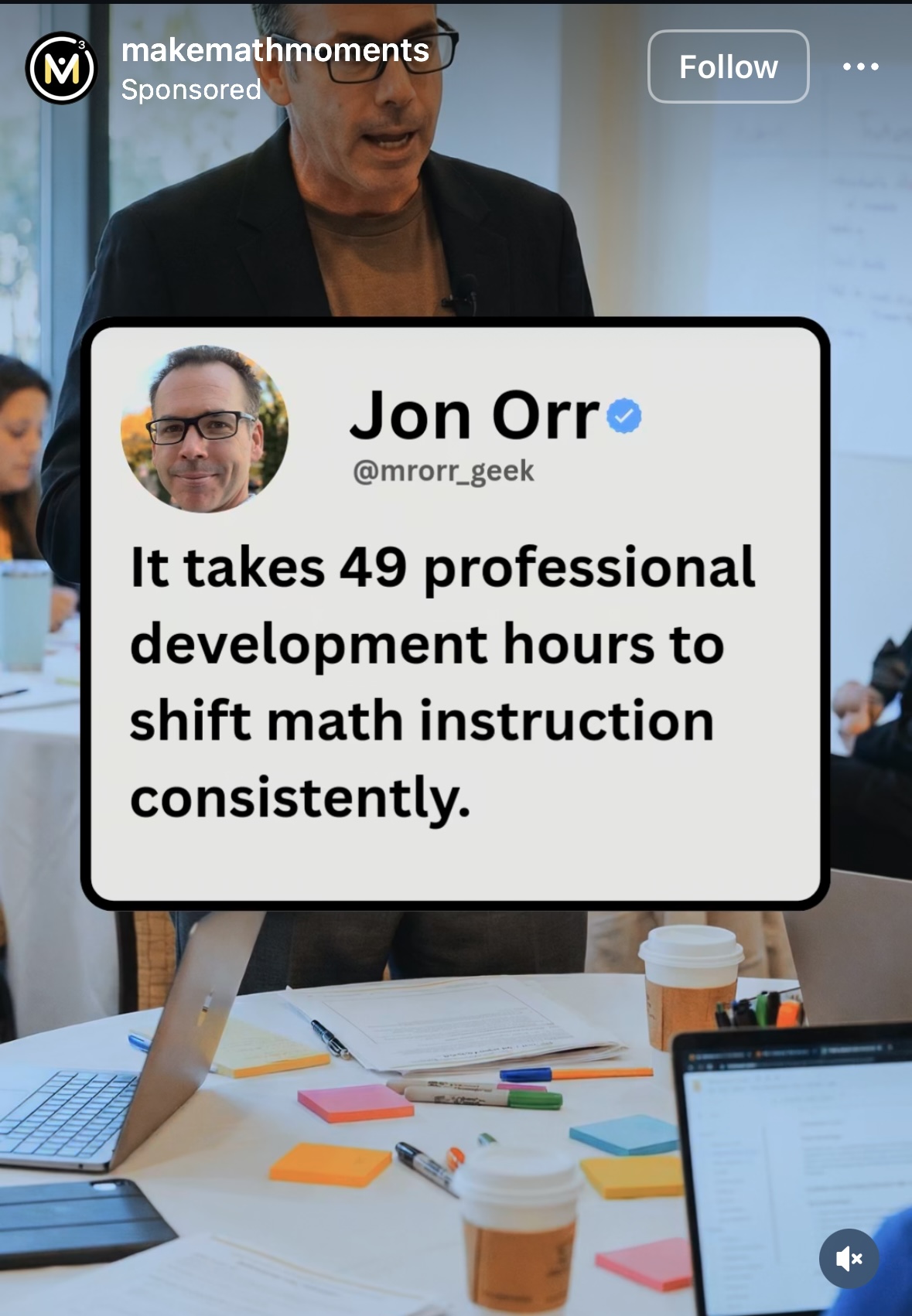
Research on Instructional Steps
“Segment skills, use clear language, [and] allow for high levels of opportunities to respond.”
Powell, S. R., Hughes, E. M., & Peltier, C. (2022). Myths that undermine math teaching.
“Have instructional scaffolds in place that can be removed if or when students no longer need them.”
Powell, S. R., Hughes, E. M., & Peltier, C. (2022).

EMBRS
Math
Research-based. Ready for the Classroom.
About Us
We are teachers, math consultants, psychologists, and ed-tech innovators.
Proprietary Clinic
Our own learning lab for students with learning disabilities.
Should Math Class be the
Survival of the Fittest?



Or should math class be like a staircase?

What we see and hear
from schools 👀
Low Student Achievement
Year over year with little change.
Hard-working Teachers
But not many with a math background.
Complicated Curriculum
Great on paper, but not practical for novice teachers or novice learners.
Significant PL Required
Hours spent out of class with little ROI.
High Teacher Turnover
Difficult to build capacity and maintain momentum.
The EMBRS Answer ✅
Detailed Scope and Sequence
Being able to answer: Why this learning, why this student, why now?
Feedback, Feedback, and More Feedback
Students receive feedback 36 TIMES in every EMBRS lesson.
Small Steps = Big Leaps
Any new skill is learned best through incremental progressions, repetition, and practice.
Easy to Use
If it’s not easy to use, it’s not worth the paper it’s printed on.
Research-Based Using WWC
Including Explicit instruction, Micro-Scaffolding, Interleaved Practice, Concrete > Representational > Abstract Continuum.
The Goal
⬆️ Life chances and
⬆️ Life choices for students.
Our Solution
What is EMBRS Math?
Expertly Designed Learning Progressions
The Map
120 lessons per grade (K-8) built on a proprietary progression of 10,000+ questions spanning Kindergarten to Algebra 1.
1K Practice Questions Per Grade
Micro-scaffolded practice to build confidence and sustain learning.
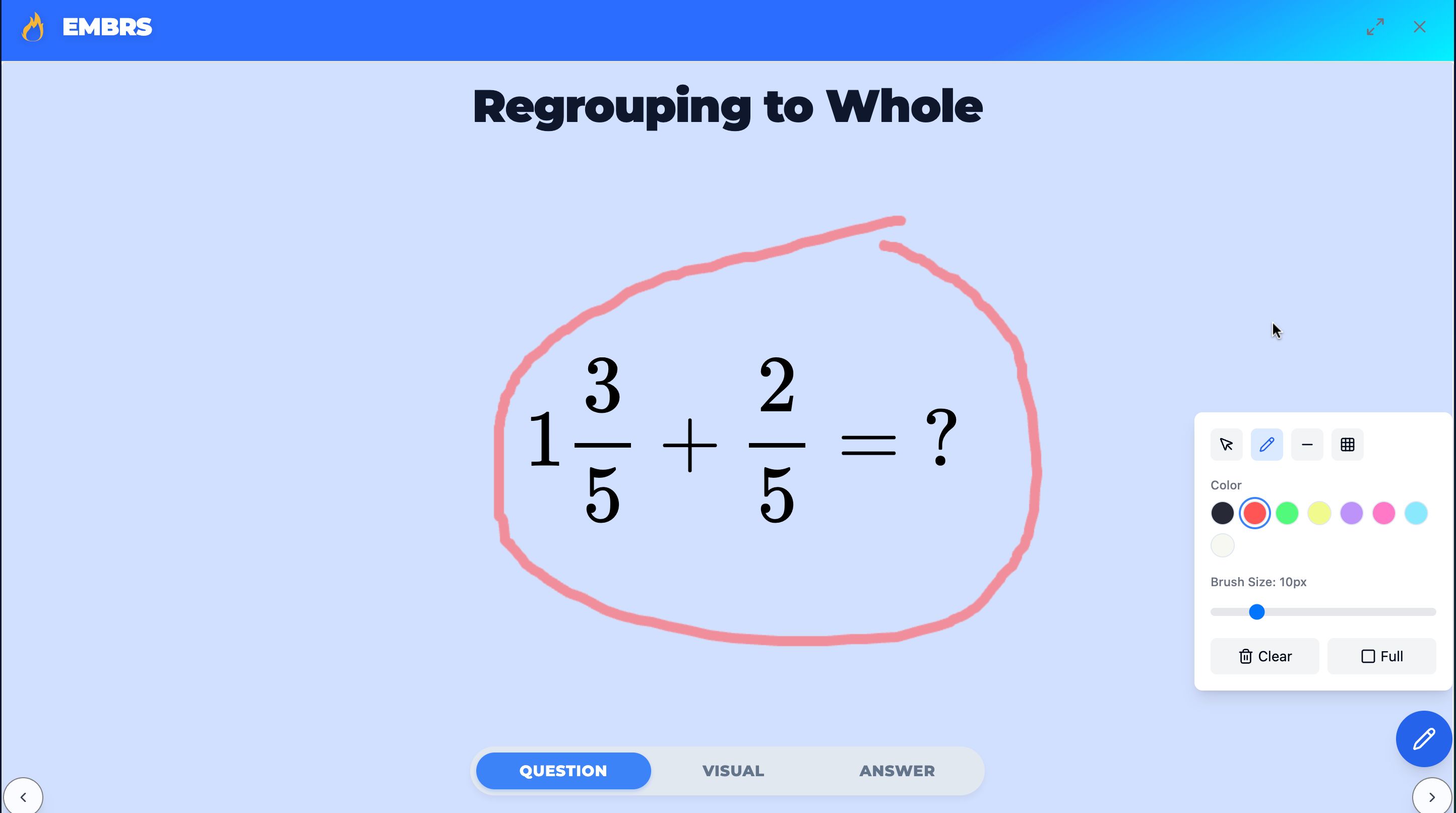
Interactive Slides
-
Flow State Engineered 36 Micro-steps based on Variation Theory keep students in the zone.
-
CRA Embedded Visual representations grounding every concept.
-
Emphasize What Matters Draw on the screen to build conceptual understanding.
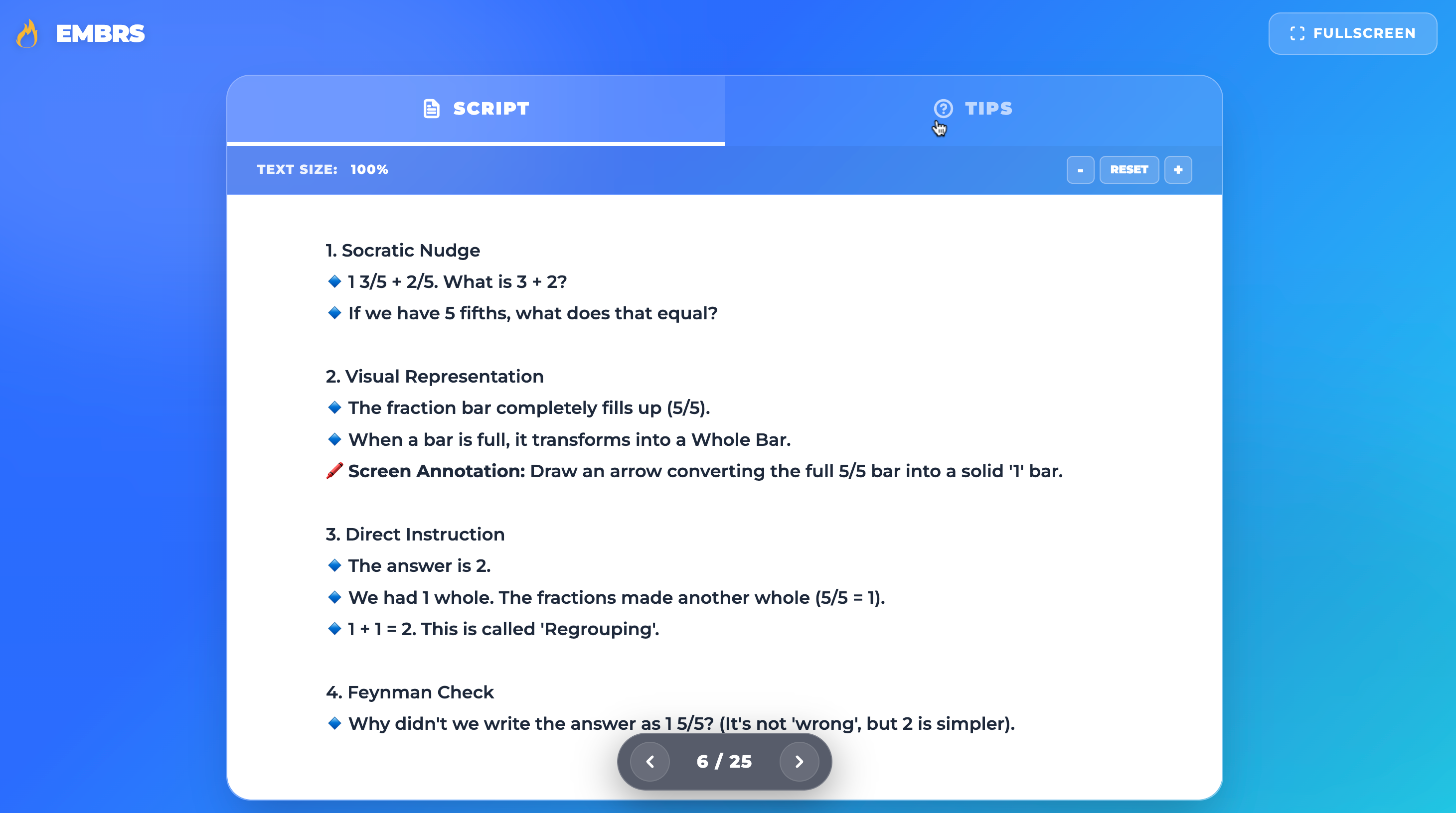
Turn-Key Teacher Guides
-
Socratic Nudge Spark thinking without spoilers. Questions that activate prior knowledge.
-
Visual Cues Don’t just point—explain. Scripted screen annotations connect the visual anchor to the math.
-
Direct Instruction The “Think Aloud” Masterclass. Clear, student-friendly explanations.
-
Feynman Check One “final “Pattern Interrupt” question to check for understanding.
-
Teacher Tips Non-examples help teachers anticipate errors. Step-Down Questions let teachers backtrack before moving on.
Two tools.
One seamless platform. 🚀
How Does It Work?
What You Need
Simple setup. Powerful results.
Computer
For the teacher
Projector
Or Interactive Flat Panel
Whiteboards
Dry erase markers & erasers for every student
1. No Raising Hands
Students write answers on whiteboards for every single step.
Everyone answers, every time, moving the class forward together.
2. The Feedback Loop
While students work on a micro-step, teachers circulate through the aisles.
The teacher observes the whiteboards to provide corrective feedback—individually or to the whole class—before advancing.
3. Taking Steps Together
In the main lesson, all students move together.
After the lesson, on-ramps for those who need it. Accelerators for those who are ready.
4. The 3-Minute Shot Clock
Designed with Cognitive Load Theory in mind.
Teachers aren’t required to be experts or lecture. Every step is designed for 3 minutes or less to keep students engaged and processing.
Components of a Lesson
A structured path to mastery.
-
Quick Review Activates prior knowledge
-
Learning Goals & Vocabulary Sets the stage
-
Instructional Loop 1 Concept acquisition
-
Instructional Loop 2 Deepening understanding
-
Practice Independent application
-
On-Ramp Targeted support
-
Accelerator Grade Level Challenges
Results from EMBRS
Implementation
Easy-to-deliver content, so teachers can focus on students.
Increasing Confidence
Every kid (and teacher) is a “math person”.
Achievement Outcomes
All students moving forward, together.
“ is the definition of doing the same thing over again but expecting different results.”